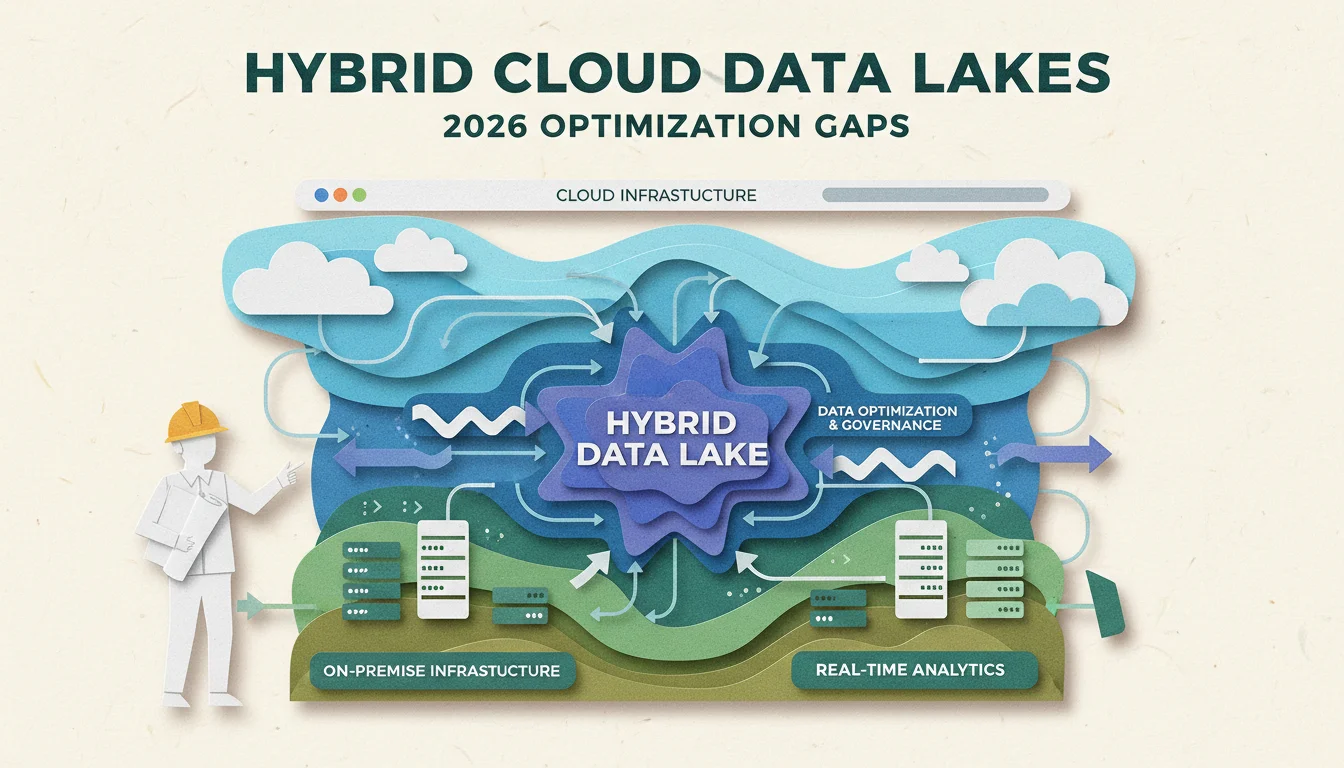
A recent industry report indicates that 68% of enterprises currently operate in a hybrid cloud environment, yet only 32% feel they have fully optimized their data strategy within this complex setup. This stark contrast highlights a significant gap between adoption and effective management, particularly when it comes to implementing data lakes for hybrid cloud environments.
Key Takeaways
- Organizations implementing data lakes in hybrid clouds report a 25% faster data ingestion rate compared to traditional on-premise solutions.
- Achieving optimal data lake performance in a hybrid cloud requires a unified metadata management layer across all environments to reduce data sprawl.
- Security breaches in hybrid cloud data lakes often stem from inconsistent access controls between on-premise and public cloud components. Standardize these policies.
- The average cost saving for enterprises migrating analytics workloads to a hybrid cloud data lake is 15% within the first two years, primarily from infrastructure elasticity.
The Staggering Cost of Data Silos: 45% of Analytics Projects Fail Due to Fragmented Data
According to a 2025 survey by Gartner, nearly half of all data analytics initiatives fail to deliver expected value, with fragmented data across disparate systems cited as the primary culprit. In a hybrid cloud scenario, this fragmentation is not just a problem. It’s an inherent architectural challenge. Data lakes, by design, aim to consolidate raw, diverse data types into a single repository, making them ideal for overcoming these silos. However, when you extend this concept across on-premise infrastructure and multiple public cloud providers, the complexity multiplies. Organizations often find themselves grappling with different storage paradigms, networking configurations, and security protocols, which can inadvertently create new, more intricate silos. I’ve seen firsthand how a well-intentioned move to a public cloud data lake can quickly become a distributed mess if the architectural planning for hybridity isn’t strong. It’s not enough to simply lift and shift. You need a strategy that accounts for data gravity, egress costs, and consistent governance across all environments.
The Data Explosion: Enterprises Managing Over 100 Petabytes of Data See 30% Growth Annually
The sheer volume of data enterprises are now handling is astounding. A report from IDC in early 2026 revealed that companies managing more than 100 petabytes of data are experiencing an average annual growth rate of 30%. This exponential increase makes the traditional data warehousing model unsustainable for many use cases, especially those requiring real-time analytics or machine learning on unstructured data. Data lakes offer the scalability and flexibility needed to accommodate this growth without constant re-architecting or prohibitive costs. In a hybrid cloud, this means intelligently distributing data based on access patterns, regulatory requirements, and computational needs. For instance, sensitive customer data might reside in a private data lake on-premise for compliance reasons, while less sensitive, high-volume sensor data could be ingested directly into a public cloud object storage solution like Amazon S3 or Azure Blob Storage. The key is establishing a unified catalog and metadata layer that provides a single pane of glass view, regardless of where the data physically resides. Without this, you’re just creating distributed storage, not a cohesive data lake.
Security Breaches in Cloud Environments Rose by 20% Last Year, Highlighting Hybrid Challenges
Cybersecurity firm Palo Alto Networks reported a 20% increase in cloud-related security incidents in 2025, a significant portion of which targeted hybrid deployments. This statistic is particularly concerning for data lakes, which often contain sensitive, raw data that hasn’t been fully cleansed or anonymized. The challenge in a hybrid cloud data lake setup is maintaining a consistent security posture across disparate environments. On-premise security controls, which might rely on network segmentation and traditional firewalls, often differ significantly from the identity and access management (IAM) policies prevalent in public clouds. Inconsistencies in access control, encryption key management, and data governance policies create vulnerabilities. For example, a misconfigured S3 bucket policy in the public cloud, combined with an overly permissive on-premise gateway, can expose vast amounts of data. My professional experience suggests that a unified security framework, incorporating zero-trust principles and granular access controls enforced at the data layer, is non-negotiable. It’s not about making one environment perfectly secure. It’s about ensuring the weakest link doesn’t compromise the entire chain.
| Factor | Hybrid Cloud Data Lake (Optimized) | Hybrid Cloud Data Lake (Suboptimal) |
|---|---|---|
| Data Strategy Optimization | 32% of enterprises | 68% of enterprises (current operation) |
| Data Ingestion Rate | 25% faster | Traditional on-premise solutions |
| Analytics Project Success | Higher (reduces fragmentation) | 45% failure due to fragmented data |
| Cost Savings (2 years) | 15% average | Lower or none |
| Security Posture | Unified, consistent controls | Inconsistent access controls, vulnerabilities |
| Data Governance | Strong, proactive frameworks | Increased complexity, compliance risks |
Data Governance Costs Soar: 35% of IT Budgets Allocated to Compliance and Risk Management
A recent Forrester report from Q4 2025 indicates that organizations are now dedicating an average of 35% of their IT budgets to data governance, compliance, and risk management. This figure shows the immense pressure businesses face to meet increasingly stringent regulations like GDPR, CCPA, and industry-specific mandates. For data lakes in hybrid cloud environments, data governance becomes an even more complex undertaking. Data can move between various jurisdictions, each with its own set of rules regarding data residency, privacy, and retention. Implementing strong data governance frameworks that span both on-premise and public cloud components is paramount. This includes automated data classification, lineage tracking, and policy enforcement tools that can identify sensitive data, monitor its movement, and apply appropriate controls regardless of its location. Without a proactive approach, companies risk hefty fines and reputational damage. It’s a heavy lift, no doubt, but the alternative is far more costly.
The Conventional Wisdom: “Just Migrate Everything to the Public Cloud” (And Why It’s Often Wrong)
There’s a pervasive narrative in the tech industry that the public cloud is the panacea for all data challenges. The conventional wisdom often dictates that organizations should “just migrate everything” to a single public cloud provider for maximum efficiency and scalability. While public clouds offer undeniable benefits, this blanket recommendation frequently overlooks critical nuances, especially for data lakes. For many enterprises, particularly those in highly regulated sectors like finance or healthcare, a full migration is neither feasible nor desirable due to data sovereignty laws, latency requirements, or the prohibitive cost of moving massive, infrequently accessed datasets. Plus, existing on-premise investments in high-performance computing or specialized hardware for specific analytics workloads can be difficult and expensive to replicate in the cloud. I’ve observed companies incur significant technical debt and operational overhead by forcing a public-cloud-only strategy when a hybrid approach would have been more pragmatic. The truth is, a well-designed hybrid cloud data lake allows organizations to retain control over sensitive or performance-critical data on-premise while using the elasticity and advanced services of the public cloud for other workloads. It’s about finding the right balance, not a one-size-fits-all solution.
Implementing a successful data lake strategy in a hybrid cloud environment demands careful planning, a unified architectural vision, and a deep understanding of data governance and security across all components. Focus on building a cohesive data fabric that bridges your on-premise and cloud infrastructure, ensuring consistent metadata, access controls, and policy enforcement. For those looking to optimize their data management strategies, understanding the innovation imperative of data catalogs is important. Also, as enterprises increasingly rely on AI for data analysis, ensuring strong AI security measures becomes paramount to protect sensitive information within these complex data ecosystems.
What is a data lake in a hybrid cloud environment?
A data lake in a hybrid cloud environment is a centralized repository that stores raw, structured, semi-structured, and unstructured data at scale across both on-premise infrastructure and one or more public cloud platforms. It allows organizations to store all their data in its native format without prior transformation, making it available for various analytical workloads.
What are the primary benefits of using data lakes in a hybrid cloud?
The primary benefits include enhanced scalability and flexibility for diverse data types, optimized cost management by placing data where it’s most economical and performant, improved data governance through centralized policy enforcement, and the ability to use specialized on-premise resources alongside advanced cloud analytics services for complete insights.
What are the main challenges when implementing a hybrid cloud data lake?
Key challenges involve ensuring consistent data governance and security policies across disparate environments, managing data movement and egress costs, maintaining unified metadata management, addressing network latency between on-premise and cloud components, and integrating diverse data sources and tools.
How does data governance differ in a hybrid cloud data lake compared to a single cloud or on-premise setup?
Data governance in a hybrid cloud data lake is more complex because it requires a unified framework that accounts for different regulatory requirements, data residency laws, and security models across both on-premise and public cloud infrastructures. It necessitates consistent policy enforcement, data classification, and lineage tracking regardless of data location, which is a broader scope than a single environment.
What technologies are essential for building a successful hybrid cloud data lake?
Essential technologies include object storage solutions (like Amazon S3, Azure Blob Storage, or Google Cloud Storage), data virtualization tools, unified metadata catalogs (e.g., AWS Glue Data Catalog), data integration platforms, strong networking solutions for connectivity, and consistent identity and access management (IAM) services that span both on-premise and cloud environments.