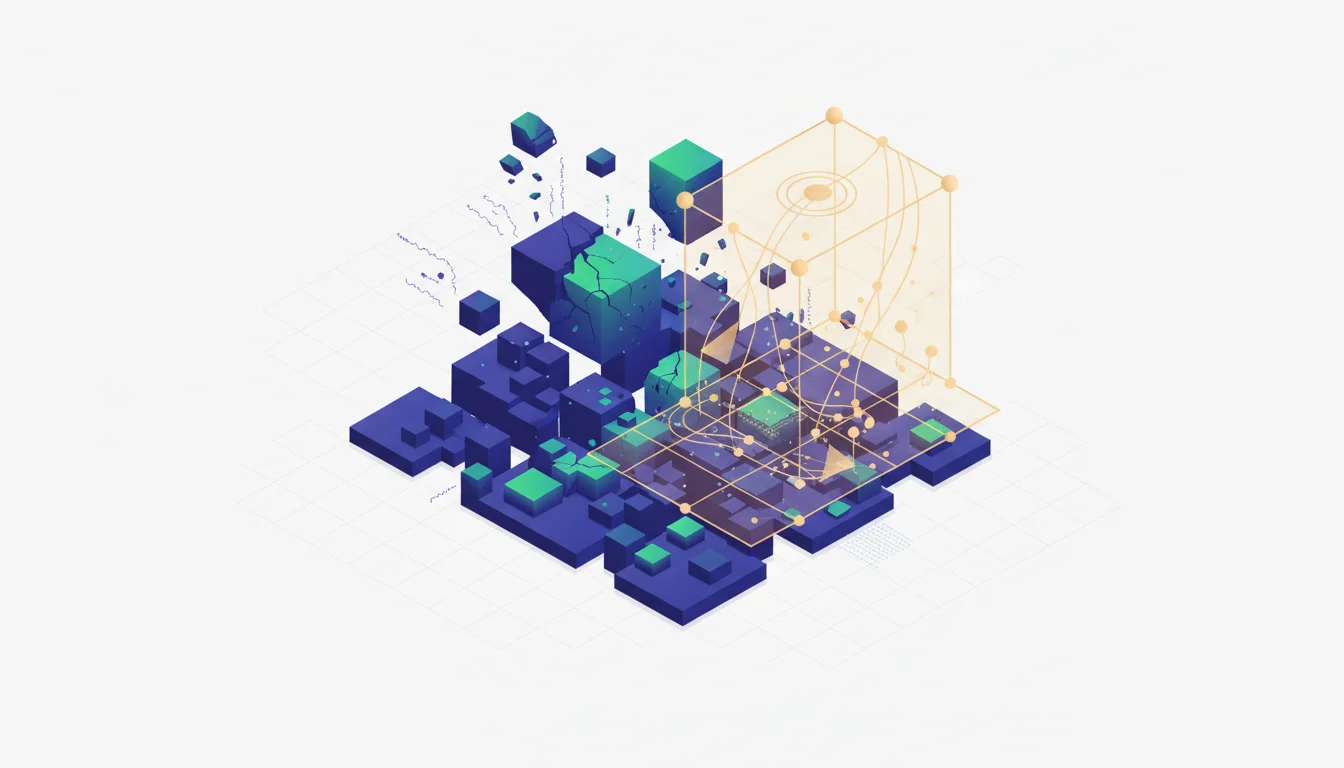
The reality that hit OmniCorp at the start of 2026 was chilling. Their main product, the “SecureVault” data storage solution, was built on encryption protocols that were quickly becoming obsolete. Dr. Aris Thorne, the chief architect with three decades in cryptography under his belt, knew the threat wasn’t just some academic paper. Quantum computing was moving out of the lab and into the real world, and it promised to shred classical encryption in minutes. This was about more than just OmniCorp’s own IP. It was about protecting the financial data of millions of their clients. The question was no longer *if* their systems would get breached, but *when*, and their only way out was to embrace the quantum internet as the future of secure communication.
Key Takeaways
- Quantum Key Distribution (QKD) relies on the laws of physics, not just math, to create secure encryption keys, which means any attempt to intercept a key is instantly detectable.
- The quantum internet is designed to create unhackable communication channels that can protect sensitive data even from the most powerful quantum computers on the horizon.
- To maintain data integrity and client trust over the next decade, businesses must start adopting quantum-resistant tech and building out the necessary infrastructure now.
- A hybrid security model is the best defense against evolving cyber threats, blending new quantum cryptographic solutions with toughened-up classical ones.
- Organizations that invest in quantum networking R&D and talent today will be the ones leading the pack in secure communications tomorrow.
| Feature | Classical Encryption | Quantum Key Distribution (QKD) | Quantum Internet |
|---|---|---|---|
| Security Principle | Mathematical complexity | Laws of quantum mechanics | Laws of quantum mechanics |
| Vulnerability to Quantum Computers | ✗ High (e.g., RSA, ECC) | ✓ Key exchange is provably secure | ✓ Communication channels are unhackable |
| Eavesdropping Detection | ✗ No direct detection | ✓ Immediately detectable | ✓ Immediately detectable |
| Integration with Existing Infrastructure | ✓ Fundamental basis | Partial (requires specialized hardware) | Partial (requires new infrastructure) |
| Cost of Major Breach (Estimated) | $500 million (by 2030) | ✗ N/A (prevents the breach) | ✗ N/A (prevents the breach) |
| Current Adoption Level | ✓ Widely used | Partial (pilot programs, e.g., OmniCorp) | ✗ Emerging technology |
The Looming Quantum Threat and OmniCorp’s Dilemma
Dr. Thorne had been waving red flags all through 2025, pushing for a proactive shift. He’d seen the timelines from groups like the National Institute of Standards and Technology (NIST), and they were not comforting. A 2024 report from the NIST Post-Quantum Cryptography Project was clear: algorithms like Shor’s could easily break the public-key systems everyone used, including RSA and Elliptic Curve Cryptography (ECC). OmniCorp’s entire security framework, like just about every other company’s, was built on that sand. The issue wasn’t a bug in their code. It was a fundamental weakness in the math itself when a quantum machine came knocking.
The board, skeptical at first, started paying attention as the quarterly reports showed cyberattacks getting more and more sophisticated. None were quantum-powered yet, but the sheer volume was enough to cause alarm. “This isn’t about some minor data leak,” Thorne argued in a tense board meeting in early January 2026. “A breach like this would be catastrophic, compromising every client record, every transaction, every bit of our proprietary code. The hit to our reputation alone would be impossible to recover from.” He then put up a slide with a projection from the cybersecurity firm Mandiant, estimating that companies unprepared for the quantum threat could face recovery costs over $500 million for a single major breach by 2030. That didn’t even include the regulatory fines. That number got their attention.
Understanding Quantum Key Distribution: The Core of Secure Communication
Thorne’s solution was a complete sea change: the quantum internet, with an immediate focus on Quantum Key Distribution (QKD). At its core, QKD uses the basic laws of physics to create a provably unhackable cryptographic key between two points. Instead of relying on math problems that are just very hard to solve, QKD is based on the fact that you can’t observe a quantum system without changing it. So if a spy tries to intercept the quantum signals (photons) carrying the key, their snooping is immediately obvious to the legitimate users, who can then scrap that key and start over.
Here’s a simple way to think about it. Alice sends Bob a stream of photons, each one polarized to represent a bit of the key. If an eavesdropper, Eve, tries to measure a photon to see what it is, she messes with its quantum state. Later, when Alice and Bob compare notes on a small sample of their key bits, they’ll see the mismatches caused by Eve’s snooping and know the channel is compromised. This is fundamentally different from classical crypto, where an attacker could copy your encrypted data and work on cracking it offline for years without you ever knowing.
OmniCorp’s Pilot Program: From Theory to Practice
Convinced by Thorne’s persistence and the frightening threat field, OmniCorp’s board finally greenlit a pilot program. They chose their Atlanta data center, right near Northside Hospital in the Peachtree-Dunwoody area, as ground zero. The objective was to build a secure QKD link between their main server farm and a critical backup facility 25 miles away in Alpharetta. This was a heavy lift that demanded specialized hardware and deep expertise, so they brought in ID Quantique, a firm known for its commercial QKD systems.
The first step was installing the QKD hardware, basically quantum transmitters and receivers, at both sites. These boxes talk to each other over standard fiber optic cables, but they’re sending single photons, not classical data bits. The real work wasn’t just plugging in the hardware, though. It was getting this entirely new security layer to play nice with OmniCorp’s existing network. “We had to rethink our security architecture from the ground up,” said Sarah Chen, the project’s lead network engineer. “Our classical encryption still handles the bulk data, but the QKD layer generates the un-copyable ‘seed’ for those encryption keys. It’s like having a master key that simply can’t be duplicated.”
The Architecture of a Hybrid Security Solution
They weren’t ripping everything out and starting over. OmniCorp went with a hybrid security strategy. Their existing Cisco network continued to handle data traffic, but they upgraded the encryption to post-quantum cryptographic (PQC) algorithms being finalized by NIST. These PQC algorithms are just classical crypto designed to resist quantum attacks, but they’re still based on math. The QKD link had a much more specific and critical job: generating and sharing the truly random, physically secured keys used to encrypt the company’s most sensitive data streams or to periodically re-key the PQC algorithms themselves.
This layered defense gave them immediate protection. It defended them against today’s threats and the expected quantum ones. Even if a quantum computer of the future could break their PQC math, the keys generated by the QKD link would remain secure because their security is based on physics. This approach also let them transition in phases, which avoided the massive disruption of a full network overhaul. As Dr. Thorne told his team, “Think of it like having two different kinds of locks on your vault. One is built to stop a crowbar, and the other is built to stop a laser.”
Challenges and Triumphs on the Quantum Frontier
Of course, the pilot had its share of headaches. A big one was just keeping the quantum states of the photons stable over that 25-mile fiber run. Quantum signals are incredibly fragile. Even tiny vibrations in the fiber cable from a passing truck could introduce errors. The team had to implement complex error correction and secure dedicated, high-quality “dark fiber” lines. Another challenge was the human element. How do you train a normal IT staff, used to classical networking, on quantum principles? They ended up bringing in physicists from Georgia Tech for some intense workshops with the network operations crew.
But for all the trouble, the pilot was a clear success. By August 2026, OmniCorp had a stable QKD link generating and sharing keys at a rate of several kilobits per second. That sounds slow, but for distributing encryption keys, it’s plenty fast. They used these keys to lock down communications for the executive team and for high-value financial transactions, like any wire transfer over $10 million. Over a three-month test, the system reported zero eavesdropping attempts on the quantum channel, proving its security worked in the real world.
The business impact was immediate. OmniCorp’s clients, especially those in finance and government, loved the explicit guarantee of quantum-safe security. The sales team started using the QKD deployment as a key differentiator, which gave them a serious leg up in a paranoid market. Reflecting on the project, Thorne noted that the real investment wasn’t just in the tech, but in their foresight. “We didn’t wait around for the ‘quantum apocalypse’ to happen,” he said at a press conference. “We saw it coming and got to work.”
The Road Ahead: Scaling the Quantum Internet
OmniCorp’s pilot is a blueprint for other enterprises. The quantum internet isn’t just theory anymore. It’s a real, albeit young, technology. While we’re still years from a global quantum network, you can buy and deploy point-to-point QKD links right now for immediate, provable security on your most critical data paths. The next big challenge is scale, specifically extending these QKD networks over longer distances and weaving them into our existing communication infrastructure. Researchers, including teams at the U.S. Department of Energy National Laboratories, are working hard on things like quantum repeaters which will act like amplifiers to boost the fragile quantum signal over hundreds or thousands of miles.
The full-blown quantum internet of the future will be a network of quantum devices that can do more than just share keys. It will enable things like distributed quantum computing and hyper-sensitive sensor networks, opening the door to applications we can’t even imagine yet. For any business paying attention, the lesson here is that preparing for this shift isn’t really optional anymore. You have to start investing in the research, the talent, and the technology adoption now.
OmniCorp’s bet on QKD was a strategic move that secured its data and gave it a real competitive advantage. Their quantum-secured channels put them ahead of the curve in an era where data integrity is everything. Moving to quantum-resistant security isn’t something to put on a five-year plan. It’s an immediate problem for any organization holding sensitive data, and integrating quantum-safe solutions now is the only way to guarantee long-term data integrity and maintain client trust.
What is the primary difference between classical encryption and Quantum Key Distribution (QKD)?
Classical encryption uses mathematical problems that are just very hard to solve with current computers. A powerful enough machine, like a future quantum computer, could break it. QKD, on the other hand, uses the laws of physics. Any attempt to eavesdrop on the key exchange physically disturbs it, which is immediately detectable. This makes the key exchange itself provably secure.
Can quantum computers break all current encryption methods?
No, not all of them. But they are a direct threat to the most common public-key systems we use for everything online, like RSA and Elliptic Curve Cryptography (ECC). An algorithm called Shor’s algorithm, running on a big-enough quantum computer, will make short work of them. Symmetric algorithms like AES are considered safer for now, but we’ll still need to use much longer keys to be sure.
Is the quantum internet widely available today?
No, a full, global quantum internet is still in the R&D phase. What *is* commercially available today are point-to-point Quantum Key Distribution (QKD) systems. Companies are deploying them now over dedicated fiber optic lines to create ultra-secure communication links between two specific, critical locations.
What are Post-Quantum Cryptography (PQC) algorithms?
PQC refers to new classical algorithms that are designed to be safe from quantum computer attacks. They’re still based on math, but they use different kinds of problems that are believed to be hard for both classical and quantum computers to solve. NIST is in the process of standardizing these, and they’ll likely be used in hybrid security setups alongside hardware like QKD.
What steps should businesses take to prepare for the quantum threat?
First, you need to inventory your data and find where you’re using encryption that’s vulnerable to a quantum attack. Then, start planning a hybrid security strategy that mixes new PQC algorithms with QKD for your most critical assets. You also need to start training your security teams on this stuff and keep a close eye on the new standards coming out of NIST.



