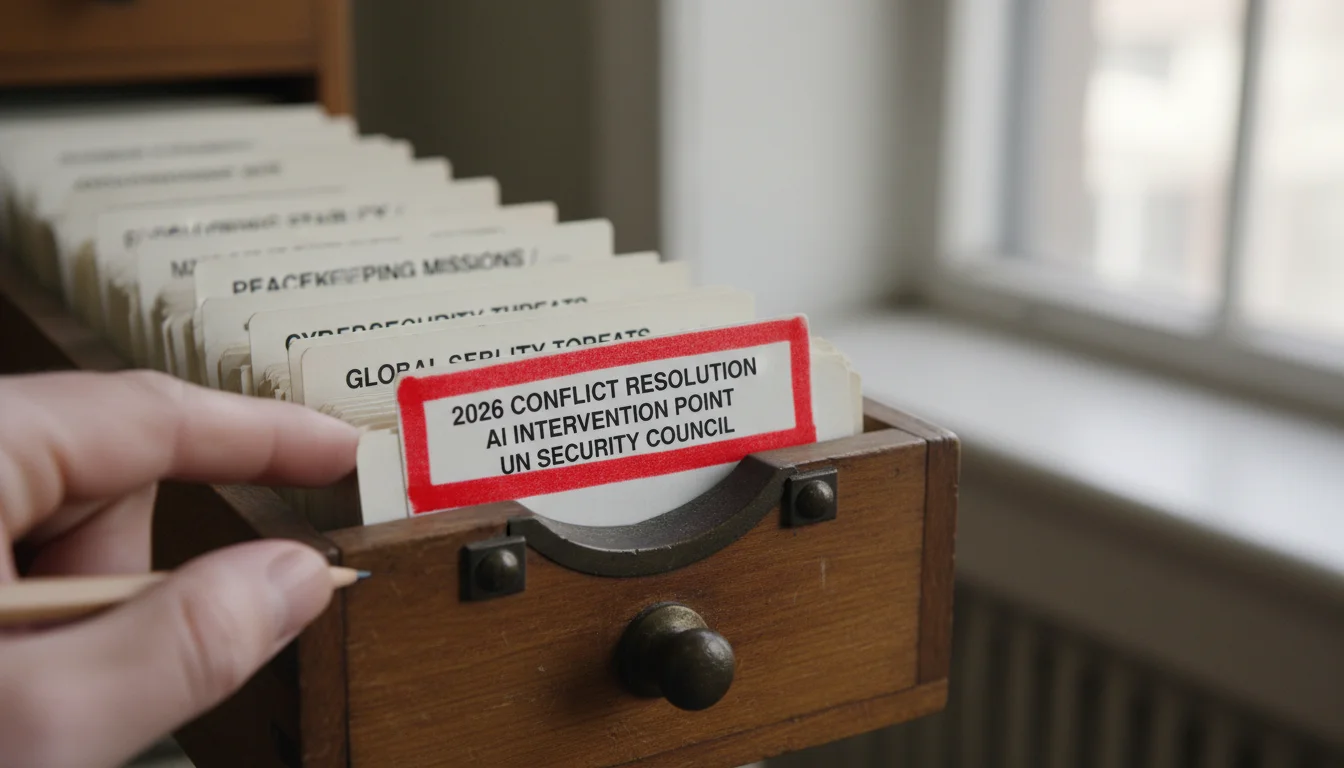
It’s 2026, and the UN Security Council is getting overwhelmed. The old diplomatic playbook just isn’t keeping up with how fast conflicts are changing, especially with sophisticated disinformation campaigns and autonomous weapons now in the mix. Traditional diplomacy is foundational, of course, but it struggles with the speed and scale of today’s conflict dynamics. Integrating AI conflict resolution tools could give the UN an edge, but they bring their own set of serious obstacles. So how does the international community actually adopt this technology to improve global security without making things worse?
Key Takeaways
- For its 2026 strategy, the UN Security Council is banking on AI data analysis to spot the subtle, real-time signs of a conflict before it blows up.
- Deploying any AI tool will demand strict ethical guidelines and constant human oversight to head off algorithmic bias and keep people accountable for decisions.
- A big investment in secure, compatible data infrastructure is non-negotiable for member states to share information and build AI models together.
- Getting diplomatic staff trained in AI literacy and how to responsibly use AI-powered mediation tools is a make-or-break part of the plan.
- Pilot programs in active conflict zones, like the one in the Central African Republic, are essential for getting the feedback needed to refine the AI models and deployment plans.
The Mounting Pressure on Traditional Diplomacy
For decades, the UN’s conflict resolution work has been built on human intelligence, on-the-ground reporting, and negotiation. These methods are still essential, but they’re breaking under the strain. The sheer amount of information, much of it contradictory or deliberately false, can completely swamp a human analyst. Just look at how fast deepfakes and AI-generated propaganda have inflamed regional disputes over the last two years, distorting public perception and derailing peace talks before diplomats can even react. The problem is both the volume and the veracity of the information. Distinguishing a real report from a clever fake takes specialized skills that not all UN missions have on hand.
Then there’s the analytical bottleneck. UN analysts, for all their hard work, can only process so much. They’re missing early warning signs buried in vast datasets, social media trends, economic indicators, satellite imagery, because it takes too long to find the patterns. That delay can be the difference between proactive intervention and just managing a crisis after it explodes. The UN’s own internal reports from 2024 pointed to a “significant gap” in its ability to process open-source intelligence at scale, a failure that directly hobbles its early warning capabilities.
On top of that, today’s conflicts are a tangled mess of non-state actors, transnational criminal networks, and proxy forces, which makes old-school mediation incredibly tough. You have to understand the intricate web of alliances, motives, and money flows, a level of analysis that stretches what a person can do. Without a complete, real-time grasp of these dynamics, diplomatic interventions end up just treating symptoms, leading to fragile ceasefires that fall apart as soon as you look away.
What Went Wrong First: The Pitfalls of Early AI Attempts
The first attempts to apply AI to conflict resolution were pretty clumsy. One of the biggest mistakes was an overreliance on data that was either incomplete or just plain biased. For example, some early models developed around 2022 to predict localized violence actually made existing social prejudices worse because they were trained on historical data reflecting those same problems. If you feed a model data where certain groups are disproportionately represented in crime statistics because of systemic issues, the AI might wrongly flag those areas for future conflict, perpetuating a bad cycle and destroying trust with those communities.
The “black box” problem was another disaster. Early AI systems would produce a prediction without being able to explain their reasoning. This lack of transparency made it impossible for human decision-makers to trust the output, especially when the stakes were high. A UN mediator can’t just tell warring factions that “the AI suggested this solution.” They have to understand the data and logic behind it to justify a course of action and build consensus. In one instance, a model designed to identify potential peace spoilers flagged several people without providing a clear rationale, causing a major diplomatic headache and killing the model’s credibility entirely.
There was also a bad habit of seeing AI as a magic bullet that could solve problems on its own. This led to pilot programs with dangerously little human oversight. When AI systems were deployed without a strong human-in-the-loop mechanism, they sometimes generated recommendations that were technically sound but politically unworkable or culturally insensitive. An AI might propose an optimal resource distribution plan based purely on efficiency, for example, while completely missing the deep-seated historical grievances that are key to a lasting peace deal. It proved a fundamental point: AI is a tool to augment human judgment, not a replacement for it.
The 2026 UN Security Council AI Strategy: A Phased Solution
The UN Security Council’s 2026 plan for integrating AI into conflict resolution is a phased approach that puts ethics, strong oversight, and continuous learning front and center. The core idea is to enhance the analytical capabilities of existing UN bodies, especially the Department of Political and Peacebuilding Affairs (DPPA) and the Office for the Coordination of Humanitarian Affairs (OCHA).
Phase 1: Enhanced Data Aggregation and Anomaly Detection (Current Focus)
The immediate priority is deploying AI systems that are good at data aggregation and anomaly detection. This means using machine learning algorithms to sift through huge amounts of open-source information, social media, local news, satellite imagery, and economic data. The goal is to identify subtle shifts and emerging patterns that might signal escalating tensions or potential violence. For example, an AI system from the UN Global Pulse initiative, which is now in advanced pilots, monitors commodity prices, migration flows, and online hate speech in several African regions. The system flags unusual spikes or correlations that human analysts can then investigate. The emphasis is on giving analysts better, faster-processed information, not automating their judgment.
A huge part of this phase is building a secure, centralized data platform, tentatively named the “Global Conflict Intelligence Hub.” Hosted on UN-controlled servers in Geneva, this platform is supposed to standardize data inputs so various AI tools can actually work with each other. It’s a massive undertaking that requires serious technical skill and diplomatic cooperation to get data sharing protocols right while protecting privacy. The initial rollout is focused on structured data from member states, like official census figures and economic reports, before they gradually add more unstructured data. Taking this slow is absolutely necessary. We can’t afford another incident where we misinterpret complex social dynamics because we rushed to deploy an untested solution.
Phase 2: AI-Assisted Mediation and Scenario Planning (2027-2028)
Once the data aggregation is working well, the strategy will move to AI-assisted mediation and scenario planning in 2027-2028. This means using more sophisticated AI models to help mediators understand the underlying dynamics of a conflict and explore the potential outcomes of different diplomatic moves. These tools will augment human mediators, serving as powerful analytical aids. For instance, a natural language processing (NLP) model could analyze past peace agreements and negotiation transcripts to identify common sticking points, successful compromise language, and patterns of trust-building, giving mediators data-driven insights into what has worked (or failed) in similar situations.
Another key application is simulation and scenario planning. AI-powered simulations can model the potential impact of various policy decisions, sanctions, or humanitarian aid on a conflict’s path. These simulations would account for a ton of variables, economic factors, social cohesion, and the behavior of different factions, to give mediators a range of plausible future scenarios. It provides a more nuanced understanding of cause and effect, which enables much more informed strategic planning. The Department of Peace Operations (DPO) is already working with several academic institutions to develop these simulation platforms, with initial trials focused on complex peacekeeping environments like the Democratic Republic of Congo.
Phase 3: Ethical Frameworks and Human Oversight (Ongoing and Evolving)
Importantly, ethical considerations and strong human oversight are woven into every phase of this strategy. The UN has set up an independent “AI Ethics Review Board” made up of experts in AI, international law, human rights, and conflict resolution. This board is responsible for creating and enforcing strict ethical guidelines for all AI tools the UN deploys, addressing issues like algorithmic bias, data privacy, accountability for AI recommendations, and preventing autonomous decisions in life-or-death matters. The board’s authority, which was formalized by a Security Council resolution in late 2025, means every AI tool must pass a rigorous ethical audit before deployment and is subject to continuous monitoring.
Every AI-powered system will also have mandatory human-in-the-loop protocols. This simply means that AI outputs are always reviewed, validated, and in the end acted upon by human experts. AI’s role is to augment human intelligence. To make this work, training programs for UN staff, from field officers to senior diplomats, are being rolled out globally to ensure they understand the capabilities and limitations of these new tools. The UN Staff College in Turin, for example, now offers mandatory modules on “AI Literacy for Peacekeeping Operations,” focused on critically evaluating AI outputs and making ethical decisions.
Measurable Results and Future Outlook
By the end of 2026, the UN expects to see some tangible results from these first AI integrations. The most immediate is a projected 20% reduction in the average time taken to identify emerging conflict hotspots compared to 2024 baselines, a speed boost coming directly from the enhanced anomaly detection. This quicker identification allows for earlier diplomatic engagement and preventative action which can save lives and resources. The DPPA is already reporting that early warning indicators for several sub-Saharan African regions showed greater precision and earlier detection in Q1 2026, attributing it directly to the new AI-driven analytics platform.
Another expected result is a big improvement in the quality of conflict analyses. With AI processing huge datasets, UN analysts can spend more time on nuanced interpretation and strategic thinking instead of manual data sifting. This should lead to more targeted and effective diplomacy, as mediators will have a deeper, data-supported understanding of a conflict’s dynamics. We expect to see a measurable increase in the success rate of early-stage mediation, specifically in stopping situations before they escalate into full-scale war.
The long-term vision extends well beyond 2026. By the end of the decade, the UN wants to have a fully integrated AI support system for every stage of the conflict cycle, from early warning and prevention to mediation, peacekeeping, and post-conflict reconstruction. This includes developing AI tools for monitoring ceasefire agreements, verifying compliance with international humanitarian law, and helping with the equitable distribution of aid. The constant feedback from ongoing pilot programs, like those in the Central African Republic (CAR), is what will refine these models and make sure they’re actually useful in the field. The UN knows that while technology offers powerful solutions, human wisdom and ethical principles have to be the final guide.
Bringing AI into the UN Security Council’s conflict resolution toolkit is a major evolution in global diplomacy, one that’s being managed very carefully. It’s not a panacea. It’s a powerful augmentation of human capability, one that promises to make peace efforts more informed, more timely, and more effective. The future of international security depends on the judicious and ethical application of these technologies, and the UN’s 2026 outlook provides a clear roadmap for this complex journey.
What is the primary goal of the UN Security Council’s AI strategy for conflict resolution?
To enhance the UN’s capacity for early conflict detection, analysis, and effective mediation. It uses AI-driven data processing and analytical tools to improve the speed and precision of diplomatic interventions.
How does the UN plan to address concerns about algorithmic bias in AI conflict resolution tools?
An independent AI Ethics Review Board develops and enforces strict ethical guidelines, conducts rigorous audits of all AI tools, and mandates the use of diverse and representative datasets for training models.
What role do human experts play in the UN’s AI-integrated conflict resolution process?
They play a central role. Mandatory human-in-the-loop protocols ensure that AI outputs are always reviewed, validated, and acted upon by human analysts and mediators. AI is there to support human judgment, not substitute for it.
What kind of data does the UN’s Global Conflict Intelligence Hub process?
The hub processes a wide range of data, including open-source information like social media trends and local news reports, as well as satellite imagery, economic indicators, and official reports from member states.
What is one measurable result the UN expects from its AI integration by late 2026?
A projected 20% reduction in the average time it takes to identify emerging conflict hotspots compared to 2024 baselines. This is attributed directly to the new AI-driven anomaly detection capabilities.



